
A Case of Opportunism: COVID-19 & Black Fungi
Anam Zafar1, Hamna Shehzad1
1 2nd Year MBBS, Islamabad Medical and Dental College, Islamabad Pakistan
Key Points
- Mucomycosis associated with delta variant of Covid-19
- It can involve all body parts including brain
- Vulnerable group are those with diabetes and hospitalized
- Treatment with intravenous amphotericin -B
Opportunism in general is the “practice of taking advantage of circumstances – sometimes when the opponent is weak”. This trait goes beyond human beings, into the order of microorganisms observed not only externally but also internally. The second wave of COVID-19 virus swept the world in form of different deadly strains; Delta strain of COVID-19 originating in India, generated headlines all over the world because of its unrivaled rate of transmission and deadly symptoms. Along the Delta strain came an imminent threat in the form of Covid Associated Mucormycosis (CAM) also known as ‘Black Fungus’. CAM cases were widely reported in last week of May 2021, and has been on the rise since. In time, reports of this Co-infection were observed in different counties of the world, Pakistan being one of them. The micro-organisms called mucors cause CAM which takes advantage of weakened immune system of COVID infectees to invade, multiply and mutate inside the human body initiating various fatal symptoms; several predisposing conditions make a person susceptible to such opportunistic infections.
In this review, vital information regarding the Black fungus-COVID 19 Co-infection has been gathered and presented.
Key words:
COVID-19, SARS COVID variants, Pandemic, Mucormycosis, Black fungus, Immune system.
‘Black fungus’ or ‘Mucormycosis’ associated with Delta strain of COVID-19 has grown into major public health concern during the pandemic. It is a rare fungal infection caused by microorganism mucor, it results in tissue blackening of infected areas, giving it a black appearance. Due to the blackening affect,
Mucormycosis was termed as black fungus. Mucorales gains entrance inside the body through respiration or skin wounds and spreads rapidly through infiltration of blood vessels. In normal conditions, upon entrance the immune system destroys it.Hhowever, in patients with suppressed immune system, the fungus after dominating the immune system starts attacking the body. The filamentous hyphae of the fungus grow over the body tissues secreting chemicals that digest tissues, and use them as food source. The skull bones, orbital bones, nasal bones and jawbones are usually targeted, if its starts attacking the skull tissues, the person hemorrhages and dies. The patient can be saved if the infection is diagnosed before it reaches the brain. Furthermore, there are various types of Mucormycosis which are classified based on who they affect.
Types of Mucormycos:
- Rhinocerebral
- Pulmonary
- Gastrointestinal
- Cutaneous
I. Rhinocerebral Mucormycosis: predominant in patients with uncontrolled diabetes; affects the sinuses as well as the brain.
II. Pulmonary Mucormycosis: prevalent in people who undergo organ or stem cell transplantation and those suffering with cancer; harms the lung.
III. Gastrointestinal Mucormycosis: targets low-weight children, whose immune system is already weak due to intake of antibiotics.
IV. Cutaneous Mucormycosis: Occurs in healthy people with effective immune systems. The fungus gains entrance through cracked skin (due to scratches or burns), transmitting through organs, reaching the target organ i.e. brain, heart and spleen might be injured.
During the COVID-19 Pandemic, Rhino-orbital mucormycosis is the most predominant type to be reported. Few Pulmonary and Gastrointestinal mucormycosis cases also being reported. Although the exact association of aforementioned infections with COVID-19 patients has yet not been identified, still some relations have been analyzed and acknowledged between certain factors and increase in Black fungus i.e. Mucormycosis infection in COVID-19 patients.
Link between COVID 19 and Black Fungus:
The immune system of the human body during COVID-19 is in a depressed state. This immunodeficiency provides the best environment for mucor spores to mature and infect the person. In addition, the steroid medicines being ingested expedites penetration of black fungus into cells by further suppressing immune system. Moreover, many COVID 19 patients are restricted to intensive care under oxygen devices, hence being subjected to high humidity levels, which facilitates the infection. There is a theory that SARS COVID-2 virus damages airway tissue and blood vessels, which makes patients more prone to fungal infection. Furthermore, increased Ferritin level in patients suffering from COVID-19 favors the growth of the fungus.
Transmission:
Black fungi is not contagious, it cannot be transmitted from one person to another in any form, unlike Covid-19. Mucor fungi produce millions of spore, which disseminate in the air, and on getting optimum environment proliferate to infect, currently the environment is being provided by the victims of COVID-19.
Most Vulnerable Groups:
Following are some conditions which increase the probability of getting infected:
Uncontrolled diabetes
Weakened immune system due to disproportionate usage of steroids, Post organ transplant / cancer
Extended stay in Intensive Care Unit (ICU) / hospital
Voriconazole therapy administered patients (used to treat severe fungal infections)
HARMFUL EFFFECTS OF BLACK FUNGUS:
Symptoms of mucormycosis appear two or three days after recovering from Covid-19. The fungal infection begins in the sinus and advance to the eyes in two to four days after the patient recovers from Covid-19. Within the next 24 hours, the black fungus will progress to the brain. The studies show that the virus causes severe pain which leads to blindness in 20-30 % of the affected patients. This infection when reaches behind
the retina of eyes presses onto optic nerve which leads to loss of vision.
As per the CDC, the manifestations of mucormycosis vary depending on the part of body affected. Pyrexia, One-sided facial swelling, nasal or sinus inflammation
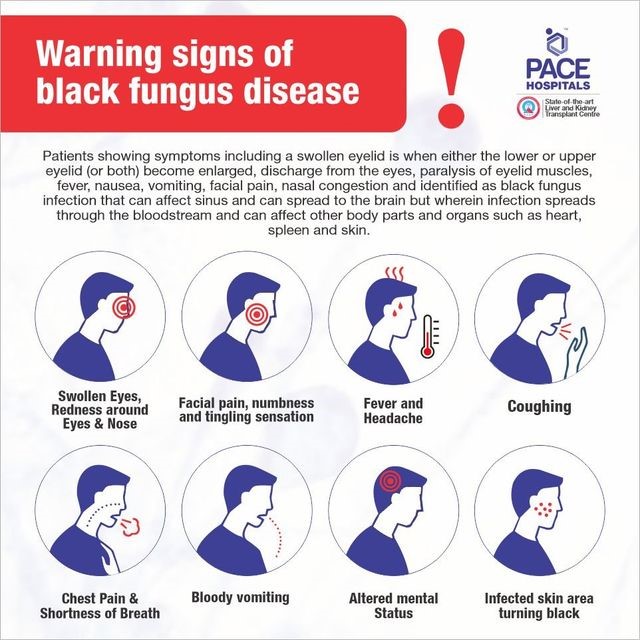
cough, and dark lesions on the nasal bridge or upper interior of the mouth that can rapidly heighten are mostly indications of rhinocerebral (sinus and brain) mucormycosis. Fever, cough, chest pressure, and shortness of breath are all signs of pneumonic (lung) mucormycosis. Early identification and diagnosis of this infection leads to better condition of patients due to prompt treatment with antifungal therapy.
Collective signs and manifestations are sinus pain, ocular pain, headache, toothache, one-sided nasal congestion and swelling or numbness colored spots on the skin , loss of eyelid, blindness and blurred vision have likewise been accounted for.
Antifungal treatment: Initially intravenous amphotericin B is used; lipid formulation is preferred. The dose starts as 5mg/kg/day, some doctors go as high as 10mg/kg/day. The therapy should be carried on for many weeks till signs of improvement are seen in the patient. Then posaconazole or isavuconazole can be used as step down treatment. The intravenous treatment of posaconazole or isavuconzole is given to the patients who do not respond to or cannot tolerate amphotericin B. Instant surgical removal and use of antifungal medicine saves the life of the affected patients. Amphotericin B, as a lipid formulation, is also used for treating this infection. Moreover, the theory that rubbing cow dung treats COVID-19 formed by few Indian groups has officially been discredited, in addition, it was stated that the usage of cow dung facilitates the spread of mucormycosis in patients suffering from COVID-19.
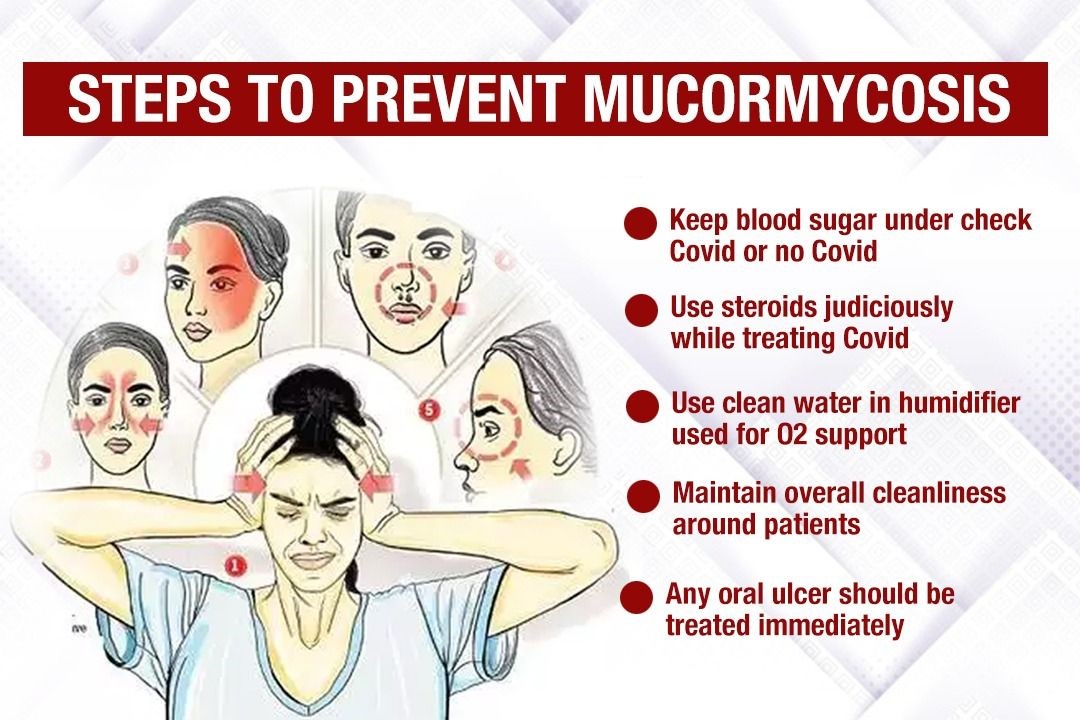
As the world desperately waits for this pandemic to end, new pages unfold; spreading a general wave of panic among the masses. Pakistan being neighbors’ with India needs to follow strict control measures to curb cases of black Fungus in immunocompromised COVID-19 patients who are more susceptible to getting infected. Front line health workers and clinicians should be informed regarding the dangers of this deadly co-infection. Extra caution should be administered while treating groups most vulnerable especially the diabetics prescribed with steroids; glucocorticoids should be administered in patients’ sensibly. Along with Mass vaccination of the public and building community trust, these are a few vital primary health care measures through which we can shield the populace during these despairing times and give them a fighting chance!
- Gokulshankar S, Mohanty BK. COVID-19 AND BLACK FUNGUS. Asian Journal of Medicine and Health Sciences Vol. 2021 Jun; 4(1):138.
- Gambhir RS, Aggarwal A, Bhardwaj A, Kaur A, Kaur R, Sohi SM. COVID-19 and mucormycosis (black fungus): an epidemic within the pandemic. Rocz Panstw Zakl Hig. 2021; 72(3).
- Gokulshankar S, Mohanty BK. COVID-19 AND BLACK FUNGUS. Asian Journal of Medicine and Health Sciences Vol. 2021 Jun; 4(1):138.
- Mishra A, Behera L, Sharma SS, Samal KC. The Rising Havoc of the Black, White and Yellow Fungi in India. Biotica Research Today. 2021 May 31; 3(5):418-20.
- Koehler P, Bassetti M, Chakrabarti A, Chen SC, Colombo AL, Hoenigl M, Klimko N, Lass-Flörl C, Oladele RO, Vinh DC, Zhu LP. Defining and managing COVID-19-associated pulmonary aspergillosis: the 2020 ECMM/ISHAM consensus criteria for research and clinical guidance. The Lancet Infectious Diseases. 2020 Dec 14.
- John TM, Jacob CN, Kontoyiannis DP. When uncontrolled diabetes mellitus and severe COVID-19 converge: the perfect storm for mucormycosis. Journal of Fungi. 2021 Apr;7(4):298.
- Garg D, Muthu V, Sehgal IS, Ramachandran R, Kaur H, Bhalla A, Puri GD, Chakrabarti A, Agarwal R. Coronavirus disease (Covid-19) associated mucormycosis (CAM): case report and systematic review of literature. Mycopathologia. 2021 Feb 5:1-0.
- Elbossaty WF. The Black Fungus is One of the Bad Conse-quences of COVID 19. Clin Onco. 2021;5(2):1-4.
- Cascella M, Rajnik M, Aleem A, et al. Features, Evaluation, and Treatment of Coronavirus (COVID-19). In: StatPearls [Internet]. Treasure Island (FL): StatPearls Publishing; 2021.
- Natesan SK, Chandrasekar PH. Isavuconazole for the treatment of invasive aspergillosis and mucormycosis: current evidence, safety, efficacy, and clinical recommendations. Infection and drug resistance. 2016;9:291.
- Gokulshankar S, Mohanty BK. COVID-19 AND BLACK FUNGUS. Asian Journal of Medicine and Health Sciences Vol. 2021 Jun; 4(1):138.
- Spellberg B, Edwards Jr J, Ibrahim A. Novel perspectives on mucormycosis: pathophysiology, presentation, and management. Clinical microbiology reviews. 2005 Jul;18(3):556-69.
- Press Information Bureau, Government of India. Available from: https://pib.gov.in/PressReleseDetailm. aspx?PRID=1718501. 2021.
- Gambhir RS, Aggarwal A, Bhardwaj A, Kaur A, Kaur R, Sohi SM. COVID-19 and mucormycosis (black fungus): an epidemic within the pandemic. Rocz Panstw Zakl Hig. 2021; 72(3).
- Bhat I, Beg MA, Athar F. A contemporary intimidation for COVID-19 patients coinfected with mucormycosis in India. J Bacteriol Mycol Open Access. 2021;9(2):69-71.
- Prakash H, Chakrabarti A. Epidemiology of mucormycosis in India. Microorganisms. 2021 Mar;9(3):523.
- Mehta S, Pandey A. Rhino-orbital mucormycosis associated with COVID-19. Cureus. 2020 Sep;12(9).
- Gokulshankar S, Mohanty BK. COVID-19 AND BLACK FUNGUS. Asian Journal of Medicine and Health Sciences Vol. 2021 Jun; 4(1):138.
- Boucher HW, Groll AH, Chiou CC, Walsh TJ. Newer systemic antifungal agents. Drugs. 2004 Sep;64(18):1997-2020.
- Nawaz S, Saleem M. Mucormycosis, The Black Fungus alarming Coinfections in Covid-19 Patients. THE JOURNAL OF MICROBIOLOGY AND MOLECULAR GENETICS. 2021 Apr 28; 2(1):15-8.
- Nawaz S, Saleem M. Mucormycosis, The Black Fungus alarming Coinfections in Covid-19 Patients. THE JOURNAL OF MICROBIOLOGY AND MOLECULAR GENETICS. 2021 Apr 28; 2(1):15-8.
- Pace Hospital. Black Fungus Infection - Mucormycosis Disease: Causes, Symptoms, Diagnosis and Treatment.Pace Hospital.2021
- Sharma, D. How can you prevent mucormycosis, the latest 'fatal' fungal infection' among covid-recovered people?Timesnow.2021

Volume 3
2021
An Official Publication of Student Spectrum at
Islamabad Medical & Dental College