
Hyperbaric Oxygen Therapy Increases Telomere Length and Decreases Immunosenescence in Isolated Blood Cells: A Prospective Trial
Moeid-Ul-Hassan
3rd Year MBBS, Islamabad Medical and Dental College, Islamabad Pakistan
Key Points
- Aging is characterized by loss of physiological capacity
- Hallmarks of aging telomere length shortening & cellular senescence
- Hyperbaric oxygen therapy induce regenerative effects
Aging is characterized by the progressive loss of physiological capacity. At the cellular level, two key hallmarks of the aging process include telomere length (TL) shortening and cellular senescence. Repeated intermittent hyperoxic exposures, using certain hyperbaric oxygen therapy (HBOT) protocols, can induce regenerative effects which normally occur during hypoxia. The aim of the current study was to evaluate whether HBOT affects TL and senescent cell concentrations in a normal, non-pathological, aging adult population. Thirty-five healthy independently living adults, aged 64 and older, were enrolled to receive 60 daily HBOT exposures. Whole blood samples were collected at baseline, at the 30th and 60th session, and 1-2 weeks following the last HBOT session. Peripheral blood mononuclear cells (PBMCs) telomeres length and senescence were assessed. Telomeres length of T helper, T cytotoxic, natural killer and B cells increased significantly by over 20% following HBOT. The most significant change was noticed in B cells which increased at the 30th session, 60th session and post HBOT by 25.68%±40.42 (p=0.007), 29.39%±23.39 (p=0.0001) and 37.63%±52.73 (p=0.007), respectively.
59 (p=0.0004) post-HBOT. In conclusion, the study indicates that HBOT may induce significant senolytic effects including significantly increasing telomere length and clearance of senescent cells in the aging populations.
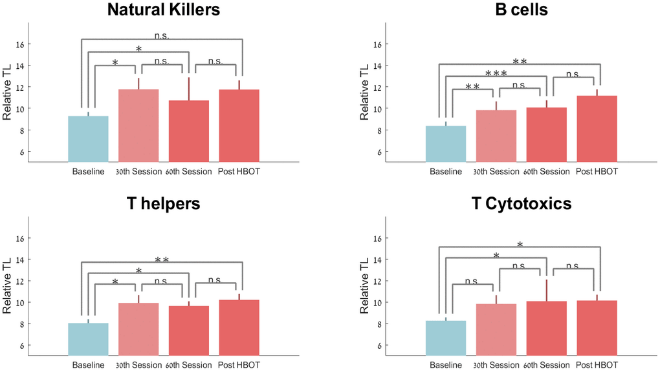
Figure 2. Telomere length changes with HBOT. Mean+SEM *p<0.05, **p<0.01, ***p<0.001.
Telomere length
Compared to the baseline, the T-helper telomere lengths were significantly increased at the 30th session and post-HBOT by 21.70±40.05 (p=0.042), 23.69%±39.54 (p=0.012) and 29.30±38.51 (p=0.005), respectively (Figure 2). However, repeated measures analysis shows a non-significant trend (F=4.663, p=0.06, and Figure 2).
In this study, for the first time in humans, it was found that repeated daily HBOT sessions can increase PBMC telomere length by more than 20% in an aging population, with B cells having the most striking change. In addition, HBOT decreased the number of senescent cells by 10-37%, with T helper senescent cells being the most effected.
A substantial number of associations between telomere length and lifestyle modifications have been observed. This has led to several interventional studies which included diet, supplements (such as omega-3, and walnuts among others), physical activity, stress management and social support. A two year trial conducted on cognitively healthy elderly adults, using a diet rich in walnuts, showed a non-significant trend to preserve telomere length when compared to a control diet. In another study which evaluated the effect of a twelve week low frequency explosive-type resistance training in elderly people, telomere length was better preserved in the intervention group without a significant increase. A recent study found that aerobic endurance training or high intensity interval training for six month increased telomere length up to 5%. Additional weight loss, yoga and stress management techniques failed to show significant telomere length changes. However, most of these studies have shown significant correlations between antioxidant activity and telomerase activity.
While many genetic and environmental factors are associated with telomere shortening, the most common suggest mechanism is oxidative stress. Oxidative stress can occur from imbalances between the production of reactive oxygen species (ROS) and cellular scavengers. Telomeres are highly sensitive to oxidative DNA damage, which can induce telomere shortening and dysfunction. The association between oxygen and/or oxidative stress and telomere length has been debated for the past several decades. Human cell culture studies consistently show that mild oxidative stress accelerates telomere shortening, whereas antioxidants and free radical scavengers decrease shortening rates and increase the cellular proliferative lifespan. Several clinical studies on pathological conditions (such as diabetes, inflammatory diseases, Parkinson’s disease) have shown correlations between oxidative stress markers, reactive oxygen species scavengers levels and telomere length. However, healthy individuals did not show similar results.
- Bellers S. The effects of Early Life Stress on brain and behavior (Doctoral dissertation). 2021.
- López-Otín C, Blasco MA, Partridge L, Serrano M, Kroemer G. The hallmarks of aging. Cell. 2013; 153:1194–217.a https://doi.org/10.1016/j.cell.2013.05.039 [PubMed]
- Tsoukalas D, Fragkiadaki P, Docea AO, Alegakis AK, Sarandi E, Vakonaki E, Salataj E, Kouvidi E, Nikitovic D, Kovatsi L, Spandidos DA, Tsatsakis A, Calina D. Association of nutraceutical supplements with longer telomere length. Int J Mol Med. 2019; 44:218–26. https://doi.org/10.3892/ijmm.2019.4191 [PubMed]
- Starkweather AR, Alhaeeri AA, Montpetit A, Brumelle J, Filler K, Montpetit M, Mohanraj L, Lyon DE, Jackson-Cook CK. An integrative review of factors associated with telomere length and implications for biobehavioral research. Nurs Res. 2014; 63:36–50. https://doi.org/10.1097/NNR.0000000000000009 [PubMed]
- Puhlmann LM, Valk SL, Engert V, Bernhardt BC, Lin J, Epel ES, Vrticka P, Singer T. Association of short-term change in leukocyte telomere length with cortical thickness and outcomes of mental training among healthy adults: a randomized clinical trial. JAMA Netw Open. 2019; 2:e199687. https://doi.org/10.1001/jamanetworkopen.2019.9687 [PubMed]

Volume 3
2021
An Official Publication of Student Spectrum at
Islamabad Medical & Dental College